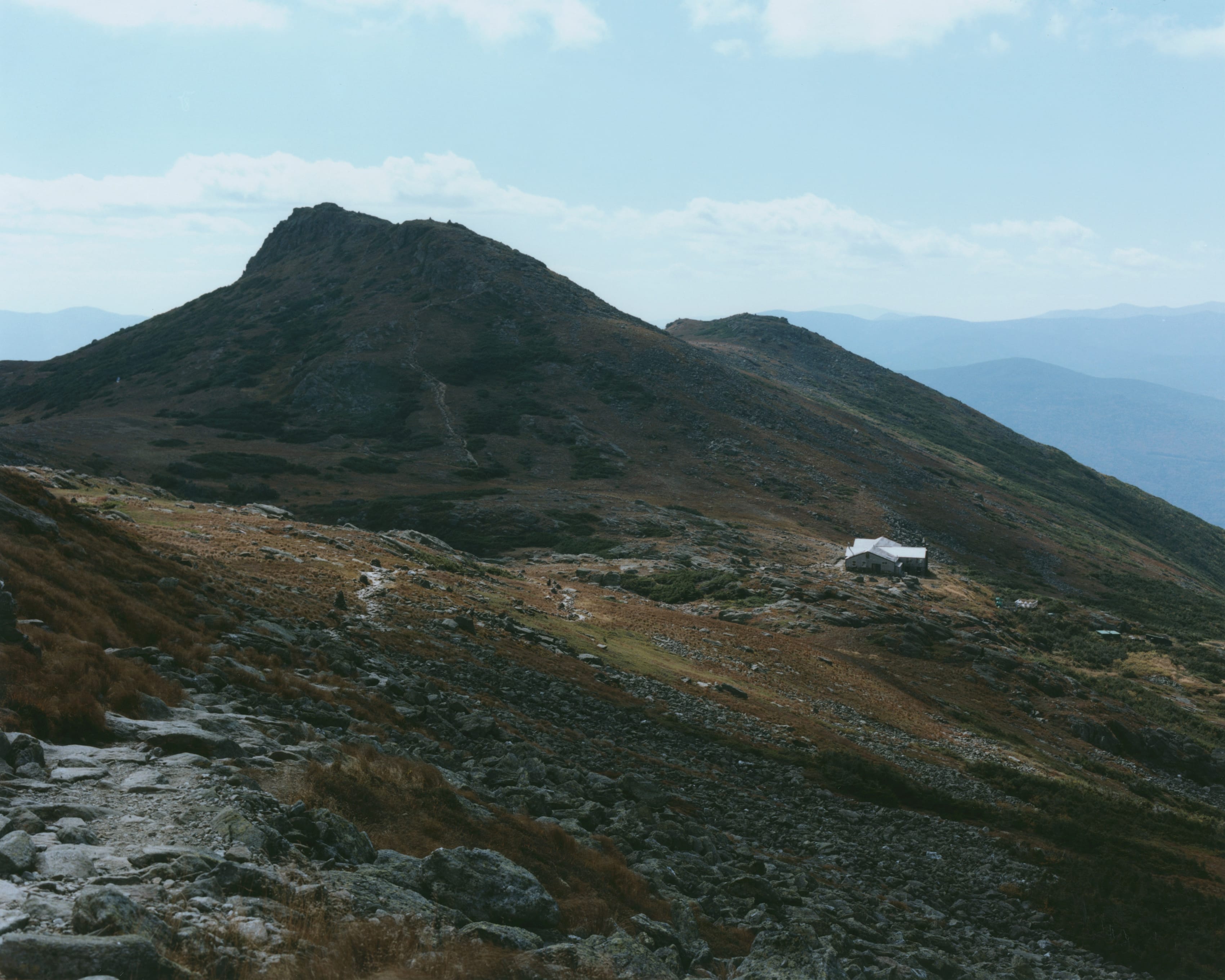



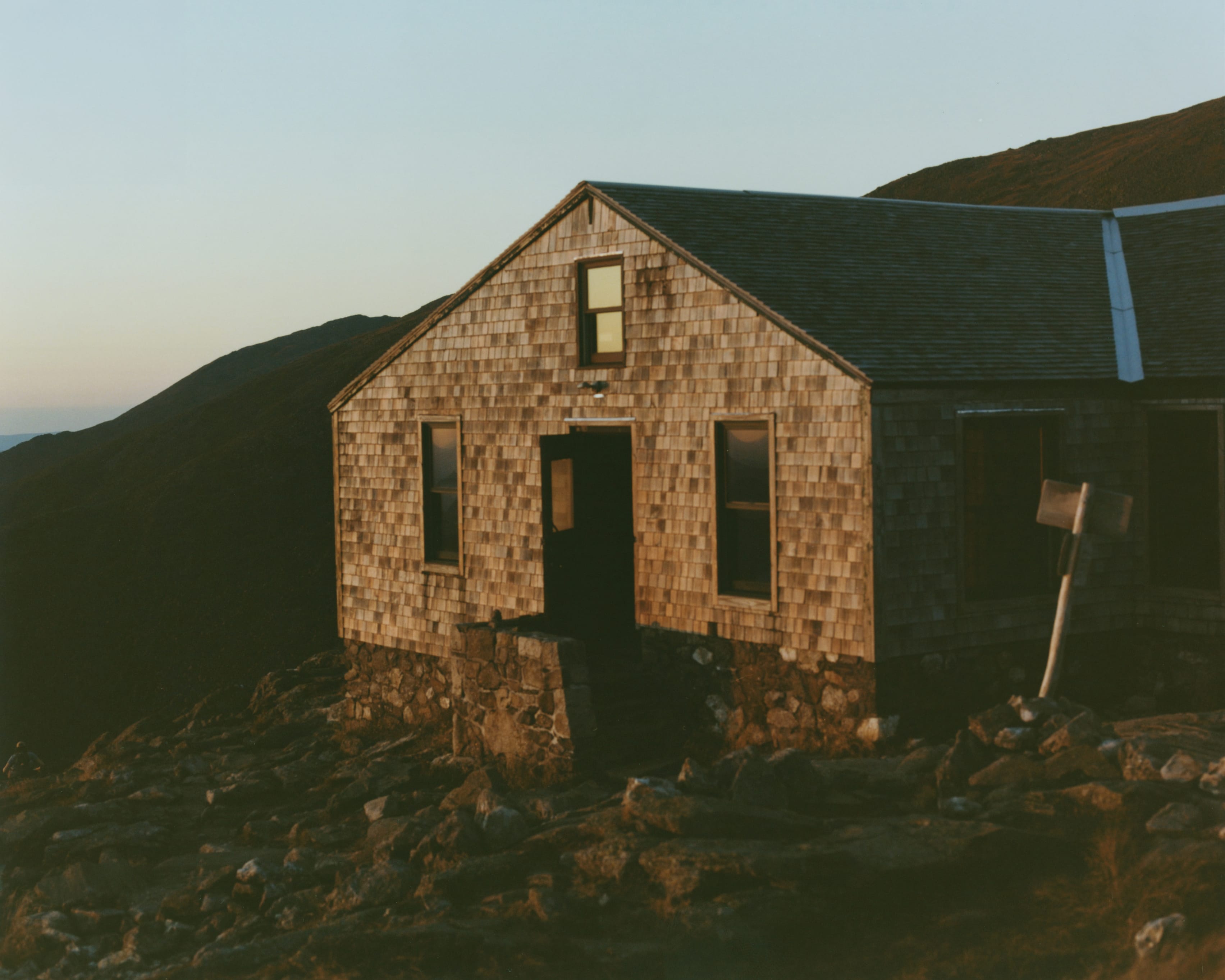
The orange light of the setting sun glows softly against the Lakes of the Clouds Hut, bathing it in a quiet, amber warmth.
It’s pre-dawn on the outskirts of the Pemigewasset Wilderness of New Hampshire. The downward rush of the North Branch Gale River and the cold moon of light cast from my headlamp are my only sensory signposts, and the rustle of any small mammal sends outsize alarms across my subconscious. In reality, I’m alone but entirely safe along the 4-mile trail that ascends to Galehead Hut, the most remote of the Appalachian Mountain Club’s eight High Mountain Huts. By the time I drop my pack on the front porch, the sun is making its climb over the far side of a trio of peaks called The Bonds. From the gravelly outlook, I watch the valley fill like a bowl with diffuse morning light, the darkness and my exertion long forgotten. It’s a familiar pattern in the White Mountains, where the hours and miles of arduous scrambling are suddenly cut with wonder: pausing to examine an illustration of a pine marten on the display board at Carter Notch Hut, only to glance out and see one poised in flesh and fur outside the window.

The White Mountain National Forest occupies more than a quarter of New Hampshire’s total landmass, a rocky dorsal slicing across the upper vertex of the Granite State before dipping into western Maine. Carved over millennia by continental collisions and glaciers, the Whites are a juvenile subrange of the Appalachians, whose ancient peaks are 10 times older than Saturn's rings.
On a Friday morning in August, I arrive at the Appalachian Trailhead with my pack and a plan to traverse the rocky spine of the Presidential Mountains, a route of roughly 20 miles and 9,000 feet of elevation. The plan will take me at a leisurely pace across the mountains to explore the historic backcountry huts dotting this high country. Situated at six- to eight-mile intervals along the Appalachian Trail, and managed by the Appalachian Mountain Club since 1888, these rustic and iconic shelters are accessible only by foot. I plan to stop at three huts before arriving back at the relative luxury of AMC’s Highland Lodge at Crawford Notch on Monday morning.
For those 25 percent of rugged souls who complete the Appalachian Trail, the centurion section through the White Mountains will be their longest continuous stretch above treeline, surrounded by an amphitheater of peaks. With those spectacular alpine-zone views comes famously unsympathetic alpine-zone weather. Bright yellow warning signs at the junctions where hikers emerge above treeline announce your arrival to the “Worst weather in America.” True to its word, that weekend in late August arrives complete with a severe wind chill advisory and slanting sheets of rain and sleet. Fickle in its fury, Sunday brings bright sunshine.
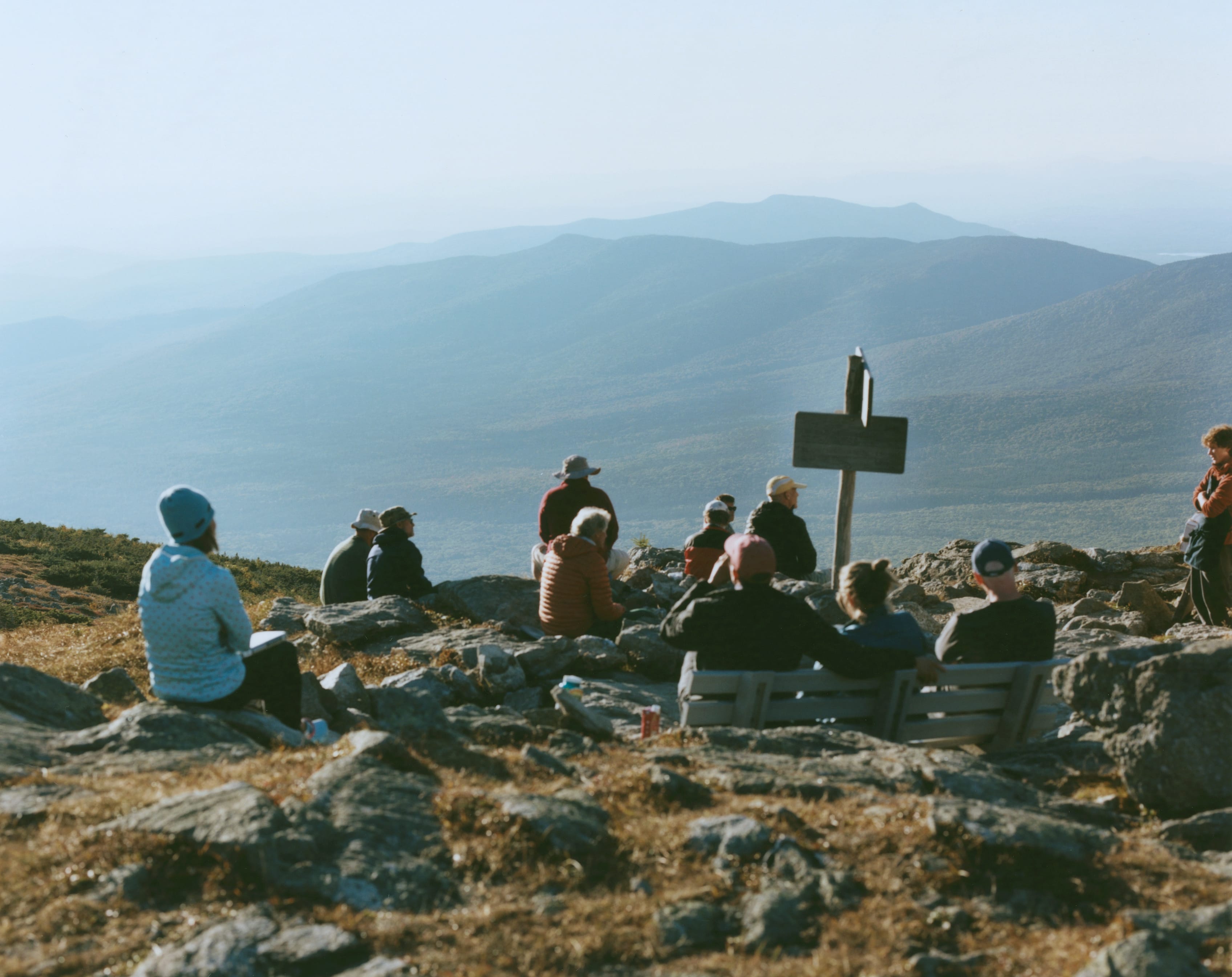
Scrambling up 3,500 feet of rain-slicked roots and granite, I emerge above the wind-dwarfed boreal spruce forest to the doorstep of Madison Spring Hut, the oldest hut site in the country. The hut’s first guests hunkered behind its three-foot-thick stone walls during the winter of 1888, a dozen years after MIT professor Edward Pickering first convened some 30-odd outdoor enthusiasts to form the Appalachian Mountain Club. Over the following 150 years, seven more huts were painstakingly constructed at high altitude to meet a growing tide of adventure tourism and create the nation’s oldest network of mountain shelters. Situated several miles apart along the Appalachian Trail, they form a spartan and self-sustained string of refuges to daytrippers and thru-hikers, complete with full-service catered lodging from June through to Fall, with some of the lower-elevation huts remaining open for self-service during the winter months. From west to east: Lonesome Lake, Greenleaf, Galehead, Zealand Falls, Mizpah Spring, Lakes of the Clouds, Madison Spring, and Carter Notch.
Built and rebuilt over decades, each hut has a character unique to its environment and elevation. Kitted out with solar panels, composting toilets, and propane fuel, the real lifeblood of the hut system is its young seasonal staff — the celebrated “hut croo” who embody the rugged, cheerful mountain culture of the Whites. Each summer, dozens of college students and recent grads apply for a handful of hut positions. Those who succeed spend their summers with sparse comforts and a hulking list of responsibilities: cooking, cleaning, maintaining the huts, volunteering for search and rescue operations, and acting as ambassadors and educators for the AMC. Through the kitchen hatch at Madison, a raucous five-strong croo prepares that night’s dinner beneath a canopy of pots and pans — autumn salad, lentil soup, focaccia, lasagne, and chocolate cake served family style.
Many croo members return season after season, like Leydi Walle, hutmaster at Lake of Clouds during my visit, a college grad with the formidable task of running a staff of 10 at the largest and most famous of the high huts. A half-mile below Mount Washington, its 94 bunks are full almost every night of the summer. Leydi describes the ideal croo member as someone who possesses an equal measure of “grit and whimsy,” capable of both physical endurance and improv. Occasionally, you’ll spot one on trail, like some rare sylvan spirit, strapped to a tall wooden pack board laden with upwards of 50 pounds of perishable items that must be hiked into the mountains biweekly. Cloistered from the outside world, a culture of rules, recipes, and friendly rivalries is passed between generations. That morning at Galehead, the former hutmaster from 1959 led the breakfast skit, demonstrating how to fold a bunk blanket correctly.

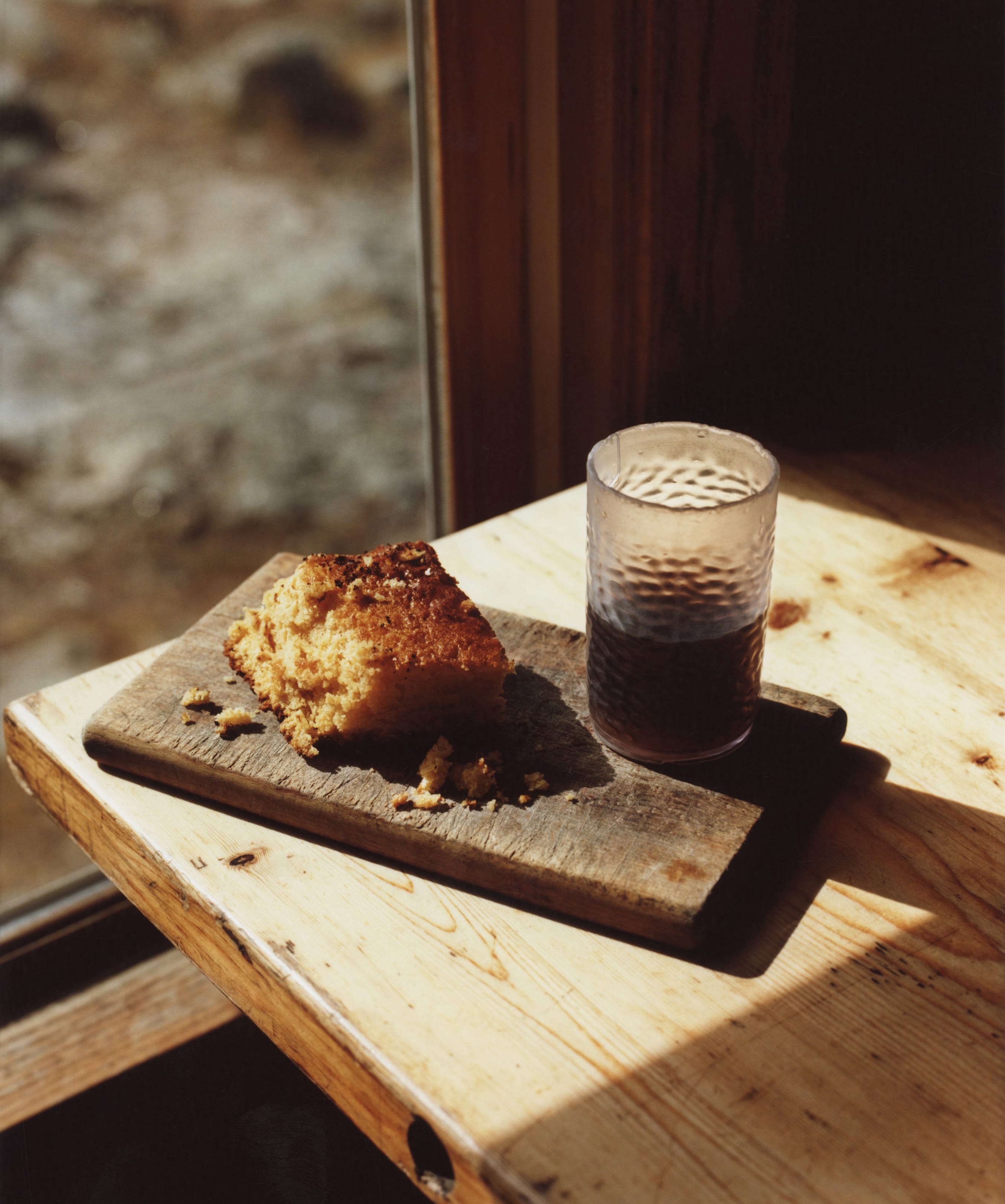
The bunkrooms themselves have a collegial atmosphere, as everyone slots into bunks stacked three high and strung with gear. After dinner, guests congregate on the long benches of the dining room to read, play cards, or attend one of the nightly talks given by the staff naturalist. By 8 p.m., or “hiker’s midnight,” the room empties. At this point in the evening, I gravitate toward the logbook archives, filled with hiker entries dating back to the sixties. On the day I was born, a band of “rough, tough creampuffs” from Connecticut arrived at Madison Spring, warning other trail users to step aside when they “come charging through.”
The Presidential Traverse links Madison Spring, Lake of Clouds, and Mizpah Spring huts. Staying a night at each affords a leisurely pace. Many undertake the trek in a day or two. The toughest stretch lies between Madison and Lakes, a route that summits Mounts Adams, Jefferson, and Washington — seven miles above timberline over terrain described by Nathaniel Hawthorne in 1882 as “masses and fragments of naked rock heaped confusedly together, like a cairn reared by giants in memory of a giant chief.” I embark from Madison in a severe wind chill, my first steps outside recalling the breathless shock of an ocean plunge.
Despite challenging conditions, the White Mountains attract hikers of all ages and ilk. I pass a septuagenarian on the final stretch of his 48 peaks, and a 12-year-old who had already completed his. Tail runners occasionally lope past, inexplicably fast and carrying nothing but a hydration vest, and I seethe beneath a 42-liter backpack and layers of wet clothes, granite like broken teeth beneath our feet. A month earlier, a local athlete named Andrew Drummond set the record for the fastest unsupported traverse of the 48, a niche challenge known as the White Mountain Diretissima. Over five rain-squalled days and nights, the 37-year-old climbed 86,000 feet over 230 miles. This fact prods like an intrusive thought, making my hamstrings shake.
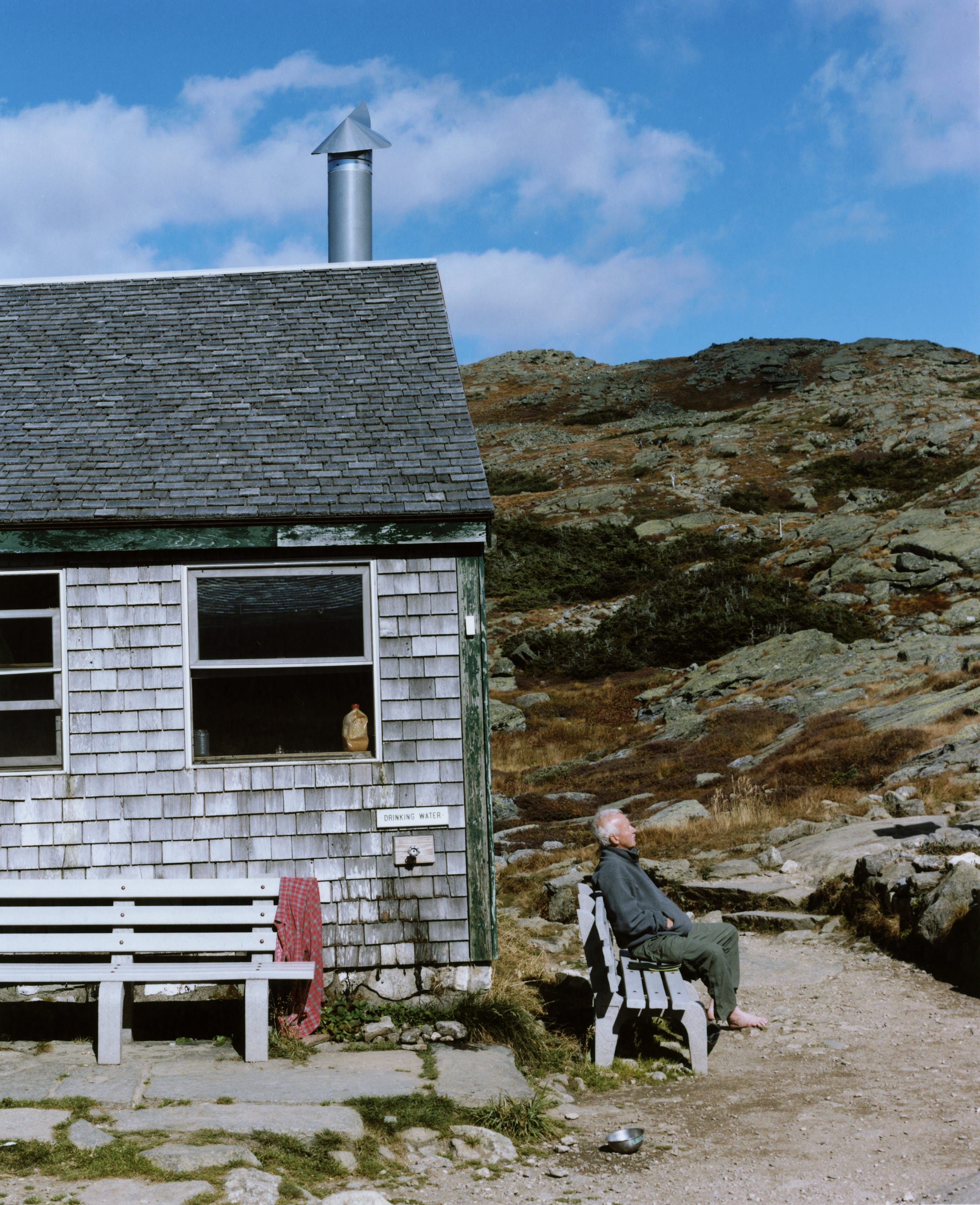
In the grand scheme of North American mountains, the Whites are a diminutive cousin to their Western counterparts. During the mid-1900s, the Whites became the site of trail development for some of the earliest outing clubs in the country, groups that favored direct and challenging ascents rather than routes engineered for travel by horse. Coupled with the unforgiving geology, the White Mountains feature few switchbacks along miles of relentless technical terrain. Combined with mercurial weather, the mountains have claimed the lives of more than 200 souls since 1849, the majority on Mount Washington.
I reach the observatory of that great summit on Saturday afternoon, wind-bruised but safe. Socked inside a cloud, there are no distant glimpses of Canada, the Atlantic, or the five states the view may afford on a clear day. Overnight, however, the cloud curtain is swept back, and breakfast is served with brilliant westerly views from the window-lined dining room.
The southern leg of the Presi follows the Crawford Path, the nation’s oldest continuously used trail since 1819, a highline connecting Mounts Monroe and Eisenhower, and Pierce that eventually drops down into Crawford Notch. A single-file track, it cuts a narrow ribbon through the northeast’s largest stretch of alpine tundra, a tight thatch of sedges, scrubby cranberry, and rare alpine species that mirror the flora of the Arctic Circle. Crouching low reveals a tapestry of tight, stunted stems and waxy leaves, diapensia and alpine grass forming dense clumps and tufts of green between the exposed rocks. The breeze pushes me along the high ridge beyond Monroe toward the bald pate of Eisenhower. At its open summit, a dozen or so hikers linger, strangers staring in shared awe at the great wall of Mount Washington, cloud layers crashing over its lower elevations like surf.
The route soon exits the alpine zone, tapering into wind-stunted spruce before dropping steeply into the boreal forests surrounding Mizpah, 3777 feet above sea level. After the Saturday rush at Lakes, Mizpah is a gentler setting — alpine austerity replaced by goldenrod and fireweed. Revived by a 4-dollar bowl of pumpkin soup, I stroll the small bunkrooms and second-floor library that make up the youngest of the high huts, built in 1964. For those who enjoy life’s luxuries, the appeal of the huts, with their communal quarters and rustic amenities, may seem mystifying. But the very existence of these lofty refuges in this rock-littered backcountry, accessed and operated through hard work and reverence for nature, is an improbable wonder that imbues every small comfort with a touch of the sublime.